
How to Choose a Print and Mail Vendor: A 10-Point Checklist for Consolidating Marketing Print, Direct Mail, and Check Printing

Make Sure Your Vendor Offers Complete Print and Mail Services

A vendor that only does one of these three well isn't a consolidation partner — it's just another vendor to add to the list you're trying to shorten. Before evaluating anything else, get a precise answer on what's produced in-house versus outsourced to a third party you'll never have direct visibility into.
What "Full-Service" Should Actually Include
A genuinely full-service print and mail vendor should be able to produce, without subcontracting:
- Commercial and marketing print — brochures, flyers, business collateral, signage
- Full-service direct mail — creative design, print production, list processing, and mailing, not just one piece of that chain
- Secure check printing and pressure seal forms
- Variable data and personalization across every job type, not just marketing
- In-house mailing list preparation and postal presorting
Red Flags to Watch For During Evaluation
Not every vendor claiming "full-service" actually is one. Watch for these signals during your evaluation calls:
- They subcontract check printing to a separate financial-print specialist
- "Direct mail production" turns out to mean they only handle design, and a courier drives your files to a separate mail house
- Vague or evasive answers about which physical facility actually runs each service line
- Sales materials that describe capabilities the account team can't confirm operationally
Asking to tour the production facility, or at minimum see documentation of in-house equipment for each service line, is a reasonable request at this stage — not an unusual one.
Verify Compliance Certifications for Sensitive Data
Check printing and transactional mail involve financial and personally identifiable information. A vendor without documented, current data-security certifications shouldn't be handling your checks or your customers' records, regardless of how polished their marketing print samples look.
Certifications to Confirm Before Signing
- SOC 2 certification — the baseline standard for any vendor touching financial or sensitive customer data
- HIPAA compliance, if your organization handles patient information
- GLBA compliance, if you're in banking, lending, or financial services
- FERPA compliance, if you're in education and handling student records
How to Actually Verify a Compliance Claim
Marketing pages listing certifications aren't verification — they're claims. Before you commit:
- Request the current SOC 2 report or audit certificate directly, not a summary
- Confirm the certification covers the specific production facility that will handle your jobs, not just a parent company or a different location
- Ask how often the certification is renewed and when the last audit was completed
- Ask what happens operationally if a data breach occurs — response time, notification process, and liability
Don't take "we're compliant" at face value in a sales conversation. A vendor confident in their security posture will hand over documentation without hesitation. Hesitation itself is useful information.
Get Real Turnaround Times, Not Advertised Ones
Ask for turnaround times based on real order volumes, not the best-case numbers printed on a website. A vendor juggling multiple service lines should be able to tell you exactly how a standard marketing print run compares to a time-sensitive direct mail drop, and how both compare to an urgent check run.
Questions to Ask About Production Timing
- What's the standard turnaround for each service line individually — commercial print, direct mail, and check printing?
- How is rush or time-sensitive production prioritized when multiple job types are competing for the same press capacity?
- What communication happens if a job is going to miss its promised date — proactively, or only when you ask?
Why Turnaround Consistency Matters More Than Speed Alone
A vendor that promises 24-hour turnaround on everything, regardless of job type or volume, is often setting an expectation they can't consistently meet during busy periods. What matters more for a long-term vendor relationship is predictability — knowing that a payroll check run will reliably ship on schedule even during a marketing campaign crunch, and vice versa.
Check In-House List Management Capabilities
Address quality determines deliverability, and deliverability determines whether your marketing spend and your check mailings actually reach the intended recipient. A capable vendor should offer list hygiene internally, rather than outsourcing it to a separate data vendor you now also have to manage, pay, and coordinate with.
Core List Services to Confirm
- NCOA (National Change of Address) processing — catches recipients who've moved
- CASS-certified address verification — standardizes and validates addresses against USPS records
- Deduplication and data cleansing — removes duplicate or malformed records before printing
- Postal presorting — organizes mail to qualify for USPS discount rates
Why This Matters for Check Printing Specifically
List accuracy isn't just a marketing concern. Undeliverable or misaddressed check mailings create real financial and compliance exposure — delayed payments, reissued checks, and unhappy recipients. A vendor with strong list management reduces that risk across every mail type they handle for you, not just campaigns.
Confirm Variable Data and Personalization Support
Whether it's a personalized marketing mailer or a check run with recipient-specific details, the vendor should support variable data printing (VDP) as a standard, built-in capability — not a specialty add-on that requires a separate quote, a separate team, and a separate turnaround estimate.
Where Personalization Actually Moves the Needle
- Marketing mailers with recipient-specific names, offers, or imagery — proven to lift response rates over generic mail
- Transactional and account-related mail requiring accurate, individualized data per piece, with zero tolerance for data-merge errors
- Check runs where names, amounts, and account details must be error-free at scale, every single run
Questions to Ask About VDP Capability
- What VDP software and print technology do they run in-house?
- How do they QA personalized jobs before print, to catch data-merge errors?
- Can they personalize across formats — postcards, letters, and check stock — using the same data file?
Review Stock and Format Options
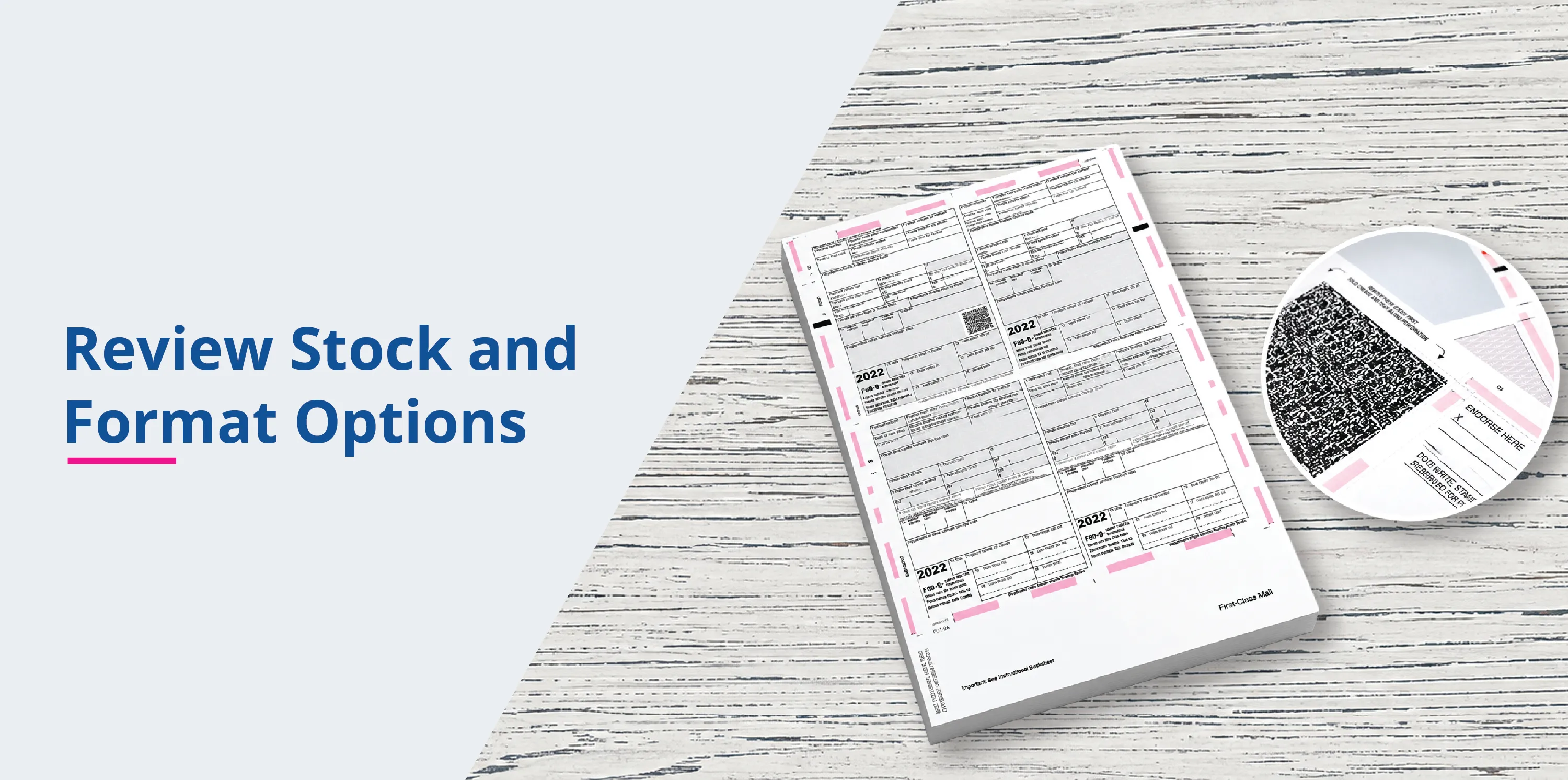
For check printing specifically, ask whether the vendor carries pressure seal stock, check stock in both legal and letter size, and multi-purpose stock — so a change in format down the line doesn't mean sourcing an entirely new supplier for one piece of your print program.
What to Confirm on Stock and Formats
- Pressure seal form stock, for security and cost-efficient mailing
- Check stock in both legal and letter size, with standard security features
- Multi-purpose stock that supports combined use cases
- A full range of direct mail formats — postcards, envelopes, brochures, self-mailers, catalogs
Why Format Range Matters for Consolidation
If a vendor only stocks a narrow range of formats, you'll eventually hit a job that forces you back out to a second vendor — undoing the consolidation you set out to achieve. Confirming format range up front avoids that slow drift back toward multiple vendors.
Look for Transparent, Itemized Pricing
Consolidation is supposed to simplify your invoicing, not complicate it. Look for a vendor who can provide clear, itemized pricing across marketing print, direct mail, and check printing — not vague bundled estimates that make it difficult to see what you're actually paying for, or to compare against a competing quote.
Questions to Ask About Pricing Structure
- Is pricing itemized by service line, or bundled into one number that's hard to break down?
- Are postage discounts and presort savings passed through transparently, with documentation?
- Are there hidden setup, proofing, or file-handling fees charged separately per job type?
- How is pricing affected by volume — and is that scale documented in the contract, or verbal?
Insist on a Single Point of Contact
One of the biggest practical wins of vendor consolidation is accountability. If a marketing mailer and a check run are both late in the same week, you shouldn't be chasing two different account managers at two different companies to figure out why — or worse, getting two different, conflicting answers.
- One account manager across every service line, not one per department
- One clear escalation path when something goes wrong
- One relationship to manage, renew, and negotiate — instead of several running on different timelines
A single point of contact also means institutional knowledge about your account — your brand standards, your compliance requirements, your preferred formats — lives in one place instead of being re-explained to a new vendor every time a job type changes.
One relationship to manage, renew, and negotiate — instead of several running on different timelines.
— TabPrint+ TeamConfirm They Can Scale With Volume Spikes
Year-end statements, tax-season check runs, and a seasonal marketing push can all spike at the same time — often the same weeks. Confirm the vendor's production capacity is genuinely built to absorb overlapping high-volume jobs without delaying your regular runs.
- Ask specifically how they handle overlapping peak periods across different service lines
- Confirm actual press and mailing capacity, not just design and account-management bandwidth
- Ask what contingency plans exist for equipment downtime or supply shortages during peak volume periods
- Ask for a real example of how they handled a past volume spike for another client
Ask for Verifiable Experience and References
Ask for references or case examples from clients in your sector, especially for check printing and compliance-sensitive mail. A vendor with genuine experience across marketing print, direct mail, and transactional printing should be able to point to concrete, checkable examples — not just a services list on their website.
- Request references from organizations of a similar size or industry to yours
- Ask specifically about their check printing and compliance track record, not just marketing print samples
- Look for client testimonials that specifically mention consistency across multiple service types, not just one
- Ask how long their average client relationship lasts — retention says more than a logo wall
A logo wall tells you who signed a contract. Average client tenure tells you who stayed. Ask for the second number, not just the first.
Frequently Asked Questions (FAQs)
Straight answers to the questions we hear most often about choosing a print and mail vendor.