
How To Plan a Successful Direct Mail Campaign From Start To Finish
Start with Clear Campaign Goals
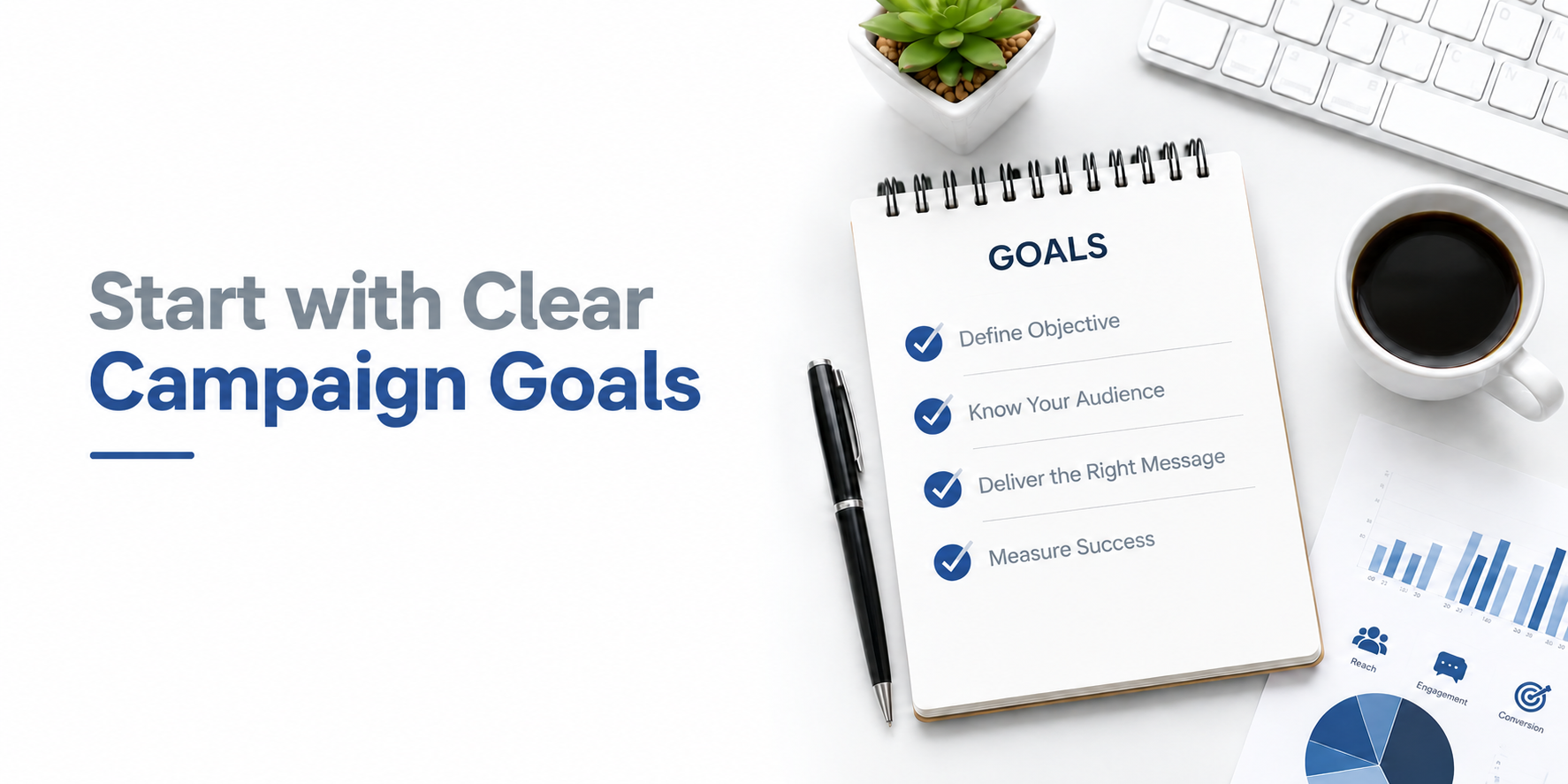
Every successful direct mail campaign begins with a clearly defined objective. Before designing postcards, selecting paper stocks, or preparing mailing lists, businesses should determine exactly what they want to achieve. Without a specific goal, it's difficult to create messaging, choose the right audience, or measure campaign success.
Campaign objectives influence every decision that follows, including the type of marketing materials you produce, the audience you target, the offer you present, and the metrics you use to evaluate performance. Establishing goals at the beginning of the planning process creates a roadmap that keeps the campaign focused and ensures that every marketing decision supports the desired outcome.
Instead of asking, "What should we mail?" businesses should first ask, "What do we want this campaign to accomplish?"
Define Your Primary Marketing Objective
Direct mail campaigns can serve many different purposes depending on the needs of the business. Some organizations focus on generating new leads, while others prioritize customer retention, event promotion, product launches, or increasing repeat purchases. Common direct mail objectives include:
- Generating qualified sales leads
- Promoting new products or services
- Driving traffic to a website or landing page
- Promoting seasonal offers or special events
- Increasing online sales
- Building brand awareness
- Retaining existing customers
- Re-engaging inactive customers
- Encouraging customers to visit a retail location
Although a campaign may produce several positive outcomes, it should always have one primary objective. Trying to accomplish multiple goals with a single mail piece often creates confusing messaging and reduces overall effectiveness.
For example, if your goal is to generate appointments for a consultation service, every element of the mail piece — from the headline to the call-to-action — should encourage recipients to schedule that appointment. A clear objective creates a focused customer journey and increases the likelihood of conversion.
Set Measurable Campaign Goals
Defining a campaign objective is only the first step. Businesses should also establish measurable goals that make it possible to evaluate campaign performance after distribution. Examples of measurable goals include:
- Generate $50,000 in sales from a promotional campaign.
- Increase website traffic by 20% during the campaign period.
- Achieve a 5% response rate from existing customers.
- Schedule 100 consultations through direct mail.
- Generate 250 qualified leads within 30 days.
Using measurable goals helps marketing teams determine whether a campaign was successful and provides valuable data for improving future campaigns.
Many businesses use the SMART framework when setting campaign objectives. Goals should be Specific, Measurable, Achievable, Relevant, and Time-bound, providing clear expectations for everyone involved in the campaign.
Choose One Clear Call-to-Action
Every direct mail piece should encourage recipients to take one specific action. One of the most common reasons campaigns underperform is because they present multiple offers or ask customers to complete several different actions at the same time. For example, asking recipients to:
- Visit the website
- Call the sales team
- Follow social media pages
- Download a brochure
- Subscribe to a newsletter
All within the same mail piece can create confusion and reduce response rates. Instead, businesses should focus on a single, clearly defined call-to-action (CTA) that aligns with the campaign objective. Examples include:
- Request a Free Quote
- Book Your Consultation Today
- Redeem Your Discount
- Visit Our Store
- Scan the QR Code
- Shop the Collection
- Register for the Event
A strong call-to-action should be visible, action-oriented, and easy to complete. Reducing friction in the customer journey significantly increases the likelihood that recipients will respond.
Identify and Understand Your Target Audience
Even the most creative direct mail campaign will struggle to deliver results if it reaches the wrong audience. Successful direct mail marketing is not about sending the highest number of mail pieces — it's about sending the right message to the right people at the right time.
Audience targeting influences every aspect of the campaign, from messaging and design to personalization and promotional offers. Businesses that invest time in understanding their audience are able to create highly relevant communications that generate stronger engagement and better conversion rates.
Rather than treating all customers the same, marketers should identify the characteristics, preferences, and behaviors that distinguish different audience groups. This allows businesses to tailor their campaigns for maximum effectiveness while reducing wasted printing and postage costs.
Understand Who Your Ideal Customer Is
Before building a mailing list, businesses should clearly define their ideal customer profile. Understanding who is most likely to purchase your products or services helps focus marketing resources on the people who matter most. Important audience characteristics include:
Demographics — demographic information helps businesses understand who their customers are. Common demographic data includes:
- Age
- Gender
- Household income
- Occupation
- Education level
- Family status
These characteristics help determine the tone, messaging, and promotional offers that will resonate with different customer groups.
Geographic Location — location plays an important role in many direct mail campaigns, especially for businesses serving specific regions or operating physical locations. Businesses may segment audiences by:
- Country
- State
- City
- ZIP Code
- Service Area
- Neighborhood
Geographic targeting ensures marketing materials are distributed where they are most relevant while helping reduce unnecessary mailing expenses.
Customer Behavior — behavioral data provides valuable insight into how customers interact with your business. Examples include:
- Previous purchases
- Purchase frequency
- Product preferences
- Website activity
- Customer loyalty
- Email engagement
- Event attendance
By understanding customer behavior, businesses can create personalized campaigns that deliver more relevant offers and improve response rates.
Build a High-Quality Mailing List
A successful direct mail campaign depends on the quality of the mailing list used. Sending professionally designed marketing materials to outdated or incorrect addresses wastes valuable printing and postage resources while reducing campaign effectiveness. Businesses should continuously maintain their customer database by:
- Removing duplicate contacts
- Updating customer information
- Verifying mailing addresses
- Eliminating inactive records
- Correcting incomplete addresses
- Segmenting recipients into relevant audience groups
A clean mailing list improves deliverability, reduces operational costs, and increases the likelihood that marketing materials reach qualified prospects. Rather than purchasing large generic mailing lists, businesses should prioritize data quality and relevance. A smaller list of highly qualified recipients often generates stronger results than a larger list with limited customer interest.
Segment Your Audience for Better Results
Audience segmentation is one of the most effective ways to improve direct mail performance. Instead of sending identical marketing materials to every customer, businesses can divide recipients into smaller groups based on shared characteristics. Common segmentation strategies include:
- Existing vs. New Customers
- Frequent Buyers
- High-Value Customers
- Geographic Regions
- Industry Type
- Product Interest
- Seasonal Buyers
- Event Attendees
Once customer segments have been identified, businesses can personalize messaging, promotional offers, and calls-to-action to better match each audience's needs. Segmentation increases campaign relevance, improves customer engagement, and helps businesses achieve better marketing results while reducing unnecessary printing and mailing costs.
Create an Offer That Motivates Customers to Take Action
An effective direct mail campaign is more than an attractive design or a professionally printed mail piece — it must give recipients a compelling reason to respond. This reason is known as your offer, and it is often the deciding factor between a successful campaign and one that fails to generate meaningful results.
Many businesses spend significant time perfecting the appearance of their marketing materials but overlook the importance of developing a clear, valuable offer. Without a strong incentive, even the most visually appealing postcard or brochure is unlikely to produce the desired response.
Your offer should answer one simple question from the customer's perspective: "Why should I act now?"
Whether you're encouraging customers to make a purchase, schedule an appointment, download a resource, or visit your store, the offer should clearly communicate the value the recipient will receive. A compelling offer reduces hesitation, increases engagement, and improves conversion rates, making it one of the most important components of any direct mail campaign.
Focus on One Primary Offer
One of the most common mistakes businesses make is trying to promote multiple products, services, or offers within a single mail piece. While it may seem like presenting more options increases the likelihood of success, it often has the opposite effect. Too many choices create confusion and make it difficult for recipients to determine what action they should take.
Instead, every direct mail campaign should revolve around one primary offer that aligns with your campaign objective. Whether you're promoting a limited-time discount, introducing a new product, offering a free consultation, or inviting customers to an event, your entire message should support that single goal.
For example, if your objective is to generate appointments, your offer might be a complimentary consultation or assessment. If your goal is to increase online sales, your mail piece could feature an exclusive discount code available only to direct mail recipients. A focused offer creates a clearer customer journey, making it easier for recipients to understand the value of your promotion and respond with confidence.
Make Your Offer Valuable
Customers receive marketing messages every day, both online and offline. To stand out in a crowded marketplace, your direct mail campaign must offer something that captures attention and provides genuine value. Effective offers often include:
- Percentage discounts
- Dollar-off promotions
- Buy One, Get One (BOGO) deals
- Free shipping
- Complimentary consultations
- Free product samples
- Exclusive member benefits
- Limited-time pricing
- Early access to new products
- Event invitations
The value of your offer should match the expectations of your target audience. Existing customers may respond well to loyalty rewards, while new prospects may require a stronger introductory incentive before engaging with your business. Rather than focusing solely on discounts, consider what your customers genuinely value. For some audiences, expert advice, convenience, exclusive access, or educational resources may be more persuasive than price reductions.
Create a Sense of Urgency
A compelling offer becomes even more effective when combined with a clear reason to act immediately. Without urgency, recipients may intend to respond later but ultimately forget about your offer. Businesses can encourage timely action by introducing limited availability or specific deadlines. Examples include:
- Offer valid through September 30.
- Limited-time introductory pricing.
- Available while supplies last.
- Register before seats are filled.
- First 100 customers receive a free gift.
- Schedule your consultation this month and save 20%.
Urgency should always be genuine and transparent. Artificial scarcity or misleading deadlines can damage customer trust and reduce the long-term effectiveness of your marketing. When used appropriately, urgency motivates recipients to prioritize your offer rather than postponing their decision.
Make Responding Simple
Even the most attractive offer can fail if the response process is complicated. Every additional step in the customer journey creates friction, increasing the likelihood that recipients will abandon the process before taking action. Businesses should make responding as simple as possible by offering convenient response options such as:
- QR codes
- Personalized landing pages
- Dedicated phone numbers
- Online appointment scheduling
- Promo codes
- Business reply cards
The easier it is for customers to respond, the higher the likelihood of conversion. Every direct mail campaign should guide recipients toward one simple action using clear instructions and visible calls-to-action.
Choose the Right Direct Mail Format
Once you've identified your audience and developed a compelling offer, the next step is selecting the most appropriate format for your campaign. The format you choose affects everything from production costs and postage to customer engagement and response rates.
Different formats serve different marketing purposes. Some are designed to communicate quick promotional messages, while others provide detailed product information or create a premium customer experience. Choosing the right format ensures your message is delivered effectively while remaining within budget.
Postcards
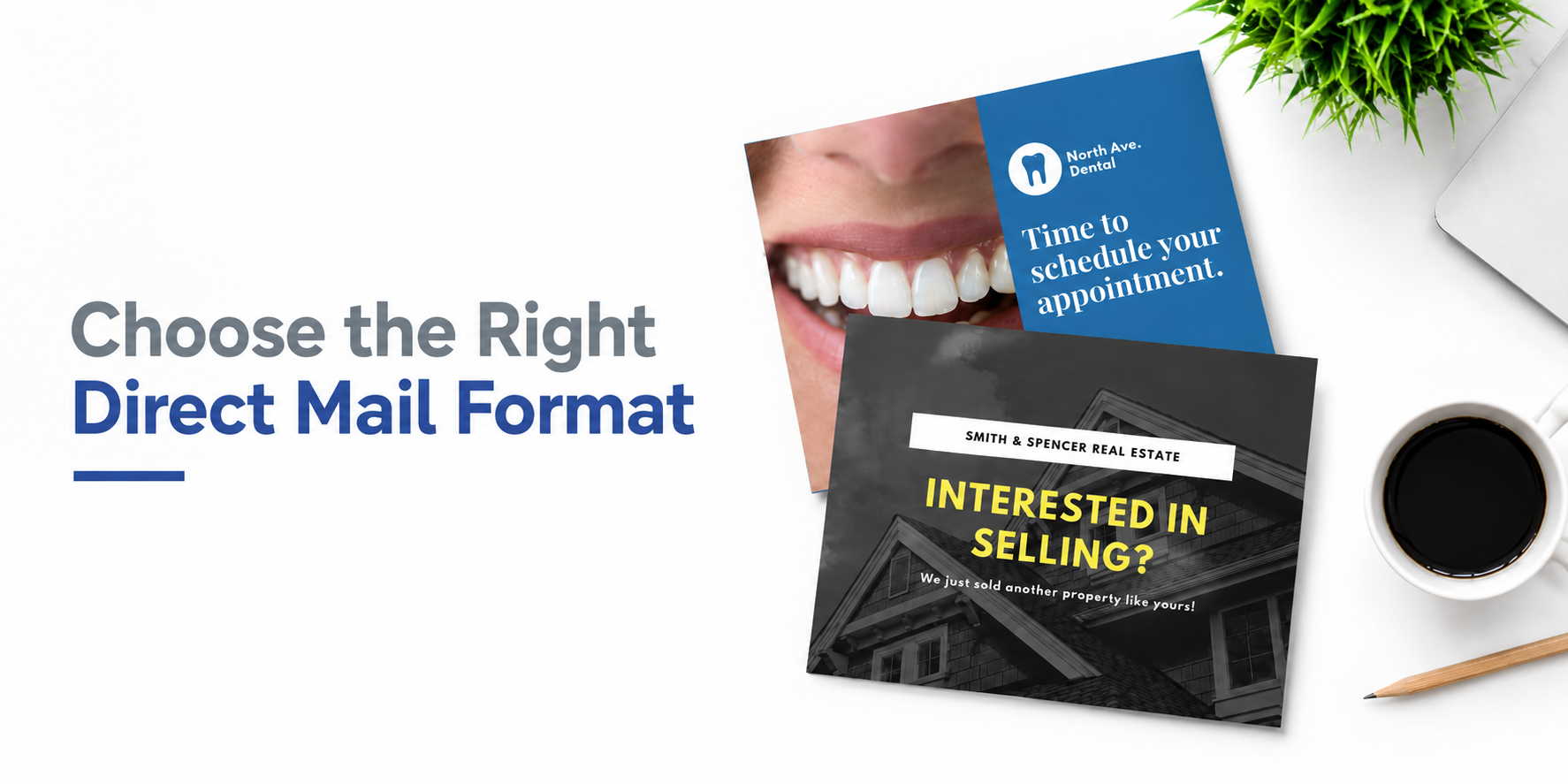
Postcards are one of the most popular and cost-effective direct mail formats available. Because recipients can immediately see the message without opening an envelope, postcards are highly effective for simple promotions, event announcements, seasonal sales, and reminder campaigns. Their compact format encourages concise messaging, making them ideal for campaigns focused on a single offer or call-to-action. Postcards are commonly used for:
- Promotional offers
- Grand openings
- Event invitations
- Appointment reminders
- Seasonal marketing
- Product launches
Their lower production and postage costs make postcards an excellent choice for businesses looking to maximize marketing reach while maintaining a controlled budget.
Letters in Envelopes
When a campaign requires more detailed communication, letters provide greater flexibility than postcards. Envelopes also create a sense of privacy and importance, making this format suitable for personalized communications. Businesses commonly use letters for:
- Financial services
- Healthcare communications
- Membership renewals
- Fundraising campaigns
- Professional services
- High-value customer outreach
Letters allow businesses to include multiple pages, personalized messaging, brochures, reply forms, or promotional inserts, creating a more comprehensive customer experience.
Brochures
Brochures provide additional space to explain products, services, or company information in greater detail. They are particularly valuable when customers require more information before making a purchasing decision. Common uses include:
- Product catalogs
- Service overviews
- Corporate presentations
- Educational materials
- Travel information
- Healthcare resources
A professionally designed brochure combines informative content with compelling visuals, helping businesses educate customers while reinforcing brand credibility.
Flyers
Flyers are ideal for distributing straightforward promotional information quickly and affordably. They are frequently used for local marketing campaigns where businesses want to reach a broad audience within a specific geographic area. Businesses often use flyers for:
- Community events
- Restaurant promotions
- Retail sales
- New business announcements
- Seasonal offers
- Real estate marketing
Because flyers are simple to produce and distribute, they offer an economical solution for businesses with limited marketing budgets.
Catalogs
Catalogs remain one of the most effective formats for businesses with extensive product offerings. Unlike smaller mail pieces, catalogs encourage recipients to browse multiple products, increasing opportunities for cross-selling and higher average order values. Retailers, wholesalers, manufacturers, and ecommerce businesses frequently use catalogs to showcase seasonal collections, featured products, and promotional pricing. Although catalogs require a larger investment than postcards or flyers, they often generate strong customer engagement when sent to qualified audiences.
Self-Mailers
Self-mailers combine many of the benefits of brochures and postcards without requiring an envelope. These folded mail pieces provide additional space for marketing content while reducing production and mailing costs. Businesses commonly use self-mailers for:
- Newsletters
- Promotional campaigns
- Multi-product advertisements
- Educational content
- Event announcements
Self-mailers are particularly effective for businesses seeking a balance between affordability and content capacity.
Selecting the Best Format for Your Campaign
Choosing the right direct mail format depends on several factors, including your campaign objective, audience, budget, messaging requirements, and desired customer experience. Before making a decision, ask yourself:
- How much information does the customer need?
- How quickly should the message be understood?
- Will recipients need additional supporting materials?
- Is personalization important?
- What is the campaign budget?
- What action do you want customers to take?
Answering these questions helps ensure your chosen format aligns with your overall marketing strategy while maximizing campaign effectiveness. Rather than selecting a format based solely on cost, businesses should evaluate how well each option supports their campaign goals. The right format not only improves customer engagement but also contributes to stronger response rates and a better return on marketing investment.
Design Direct Mail That Captures Attention and Drives Action
The success of a direct mail campaign depends not only on who receives it but also on how effectively the message is presented. Within seconds of picking up a mail piece, recipients decide whether it deserves their attention or belongs in the recycling bin. An effective design captures interest immediately, communicates value clearly, and guides readers toward taking action.
Good direct mail design goes beyond attractive graphics. Every design element — from the headline and imagery to the layout and call-to-action — should work together to support the campaign objective. Businesses often make the mistake of overcrowding their mail pieces with excessive text, multiple offers, or inconsistent branding, making it difficult for recipients to understand the message.
The most successful direct mail campaigns combine compelling visuals with concise messaging, ensuring that recipients immediately recognize the offer and understand the next step they should take.
Write Headlines That Capture Immediate Attention
Your headline is often the first thing recipients notice, making it one of the most important elements of any direct mail piece. A strong headline should immediately communicate value and encourage the reader to continue exploring the content. Rather than focusing solely on your business, your headline should address a customer need, solve a problem, or highlight a clear benefit. Examples of effective headlines include:
- Boost Your Brand with Custom Marketing Materials
- Make Your Marketing Stand Out with Premium Printing
- Discover Faster and More Affordable Direct Mail Solutions
- Save 25% on Your Next Print Order
- Exclusive Offer for Local Businesses
Effective headlines are concise, benefit-focused, and easy to understand. They should communicate your primary message within just a few seconds of being read.
Use Visual Hierarchy to Guide the Reader
Visual hierarchy refers to the way information is organized on the page so readers naturally focus on the most important elements first. A well-designed mail piece directs attention from the headline to supporting information and finally to the call-to-action without overwhelming the reader. Businesses can improve visual hierarchy by:
- Using larger fonts for headlines
- Keeping body text short and readable
- Highlighting key benefits
- Creating sufficient white space
- Using contrasting colors for important information
- Positioning calls-to-action prominently
Rather than filling every available space with content, successful designs prioritize clarity. Clean layouts make marketing materials easier to read and increase the likelihood that recipients will engage with the message.
Maintain Consistent Branding
Consistency builds recognition and trust. Every direct mail piece should reflect your company's established brand identity through consistent use of logos, colors, typography, imagery, and messaging. Brand consistency helps customers immediately recognize who the communication is from and reinforces professionalism across every marketing channel. Whether recipients receive a postcard, brochure, flyer, or catalog, they should experience the same visual identity they encounter on your website, social media platforms, and other marketing materials. Strong branding also strengthens long-term customer relationships by creating familiarity and confidence in your business.
Personalize Your Design with Variable Data Printing
Modern direct mail campaigns are far more effective when they feel personal. Variable Data Printing (VDP) enables businesses to customize individual elements within each printed piece without interrupting production. Instead of producing thousands of identical postcards, businesses can personalize:
- Customer names
- Company names
- Product recommendations
- Regional offers
- Promotional codes
- QR codes
- Images
- Headlines
- Calls-to-action
Personalization extends beyond addressing recipients by name. The most effective campaigns tailor content to customer interests, purchase history, location, or previous interactions with the business. Customers are far more likely to engage with marketing materials that feel relevant to their specific needs, making personalization one of the most valuable tools for improving campaign performance.
Create a Strong Call-to-Action
Every successful direct mail campaign encourages recipients to complete one specific action. Without a clear call-to-action (CTA), even the most attractive marketing piece may fail to generate meaningful results. Your CTA should be:
- Clear
- Action-oriented
- Easy to follow
- Highly visible
- Closely connected to your campaign objective
Examples include:
- Request Your Free Quote
- Shop Now
- Schedule Your Consultation
- Scan the QR Code
- Visit Our Website
- Call Today
- Redeem Your Offer
- Register for the Event
Avoid asking customers to complete multiple actions within the same campaign. A single, focused CTA improves clarity and increases conversion rates.
Prepare Your Files for Professional Printing
Once your marketing materials have been designed, the next step is preparing them for production. Even the most creative design can experience delays or quality issues if print files are not properly prepared.
Professional print preparation ensures that colors reproduce accurately, text remains sharp, images appear clear, and finished materials meet production specifications. Taking the time to review artwork before printing reduces costly mistakes and prevents unnecessary production delays. Working with an experienced commercial printer helps ensure every file is optimized for high-quality output.
Choose the Right Paper Stock
Paper selection influences both the appearance and durability of your marketing materials. Different paper stocks create different impressions depending on the purpose of the campaign. Common options include:
- Gloss Paper : enhances color vibrancy and image quality, making it ideal for postcards, brochures, catalogs, and promotional materials featuring high-quality photography.
- Matte Paper : offers a sophisticated, non-reflective finish that's easier to write on and ideal for informational materials, newsletters, and professional communications.
- Premium Cardstock : provides durability and creates a premium feel, making it an excellent choice for postcards, invitations, presentation materials, and luxury marketing campaigns.
Choosing the appropriate paper stock should balance appearance, functionality, and budget while supporting your campaign objectives.
Digital Printing vs. Offset Printing
Selecting the right printing method helps businesses achieve the best balance between quality, speed, and production costs.
Digital Printing is ideal for small print runs, personalized marketing materials, fast turnaround, frequent updates, and Variable Data Printing. Because digital printing requires minimal setup, it offers greater flexibility and is particularly useful for campaigns requiring customization.
Offset Printing is best suited for large-volume campaigns, high-quality image reproduction, consistent color accuracy, and lower cost per unit on large orders. Businesses should evaluate campaign size, timeline, personalization requirements, and budget before choosing the most appropriate printing method.
Review Artwork Before Production
Proofreading is one of the most important steps in the printing process. Once materials enter production, correcting mistakes often requires costly reprints and delays. Before approving artwork, businesses should verify:
- Spelling and grammar
- Contact information
- Website URLs
- Phone numbers
- QR codes
- Promotional pricing
- Dates
- Product information
- Image quality
- Brand consistency
It's also recommended to review both digital and printed proofs whenever possible. Seeing a physical proof helps identify layout or color issues that may not be visible on a computer screen.
Understand Print Specifications
Professional printing requires artwork that meets specific production standards. Files should be prepared according to your print provider's specifications to ensure accurate trimming, color reproduction, and finishing. Important print specifications include:
- High-resolution images (300 DPI)
- CMYK color mode
- Bleed area
- Safe margins
- Embedded fonts
- Correct page dimensions
- Vector logos whenever possible
Providing production-ready files minimizes delays and ensures the finished marketing materials meet professional quality standards.
Perform a Final Quality Check
Before approving your campaign for printing, conduct one final review of every component. Your quality checklist should include:
Mailing list verified · Artwork approved · Paper stock confirmed · Print quantities verified · Personalization reviewed · Postal requirements confirmed · Call-to-action tested · QR codes functioning · Landing pages active · Contact information accurate.
A thorough quality control process reduces production errors and helps ensure your direct mail campaign reaches customers exactly as intended. Taking time to review every detail before printing may seem like a small step, but it can save businesses significant time, money, and resources while improving the overall success of the campaign.
Execute and Launch Your Direct Mail Campaign
Planning and production are only part of a successful direct mail campaign. Once your marketing materials have been printed and prepared for distribution, it's time to execute your campaign. Proper execution ensures that your mail reaches the intended audience on schedule, complies with postal requirements, and supports your overall marketing timeline.
Many businesses invest heavily in design and printing but underestimate the importance of campaign execution. Delays in mailing, incorrect delivery dates, or poor coordination with other marketing channels can reduce the effectiveness of even the most well-designed campaign. A carefully managed launch helps maximize visibility, improve customer engagement, and increase response rates.
Develop a Realistic Campaign Timeline
Successful direct mail campaigns don't happen overnight. Every stage of the project — from planning and design to printing, mailing, and response tracking — requires sufficient time to be completed accurately. A typical campaign timeline includes:
- Campaign Planning : define campaign goals, identify your target audience, and develop your marketing strategy, including your offer, mail format, and budget.
- Design and Content Development : prepare the artwork, write persuasive marketing copy, and review all promotional materials for accuracy and consistent branding.
- Printing and Production : allow adequate time for proof approvals, print production, finishing, addressing, inserting, and quality inspections.
- Printing and Production : allow adequate time for proof approvals, print production, finishing, addressing, inserting, and quality inspections.
- Mailing and Distribution : coordinate with your mailing provider to schedule the most appropriate mailing date, mailed early enough for recipients to respond.
Building realistic timelines reduces production pressure while minimizing costly last-minute changes.
Perform Final Quality Assurance
Before your campaign enters the mail stream, every component should undergo a final quality review. Small errors such as incorrect phone numbers, broken QR codes, outdated pricing, or inaccurate addresses can significantly reduce campaign performance while increasing unnecessary costs. Quality assurance should include verifying:
- Customer mailing lists
- Personalized data
- Artwork approval
- Contact information
- Website URLs
- QR codes
- Promotional offers
- Mailing quantities
- Paper specifications
- Print quality
- Postal compliance
A thorough review helps prevent production errors while ensuring recipients receive professional, accurate marketing materials.
Coordinate with Other Marketing Channels
Direct mail delivers stronger results when it supports a broader marketing strategy rather than operating independently. Coordinating your campaign with digital marketing creates multiple customer touchpoints and reinforces your message across different platforms. Businesses often synchronize direct mail with:
- Email marketing campaigns
- Social media advertising
- Google Ads
- Landing pages
- SMS marketing
- Event promotions
- Sales team outreach
For example, a customer may first receive a promotional postcard, then see a related social media advertisement a few days later, followed by an email reminder before the promotional deadline. This integrated approach improves brand recognition and increases the likelihood of customer engagement.
Rather than viewing direct mail as a standalone marketing channel, businesses should position it as part of a comprehensive omnichannel marketing strategy.
— TabPrint+ TeamMeasure Campaign Performance and Optimize Future Campaigns
Launching your campaign is only the beginning. The most successful businesses continuously evaluate campaign performance to understand what worked, identify opportunities for improvement, and maximize future marketing investments.
Measuring results allows businesses to move beyond assumptions and make data-driven decisions. Every campaign provides valuable insights that can improve audience targeting, promotional offers, printing strategies, and overall marketing effectiveness. Without measurement, it's impossible to determine whether a campaign achieved its objectives or how future campaigns can perform even better.
Track Meaningful Performance Metrics
Before launching your campaign, establish the key performance indicators (KPIs) that will be used to evaluate success. These metrics should align with the campaign objectives established during the planning stage. Common direct mail KPIs include:
- Response Rate : the percentage of recipients who responded to your campaign by scanning a QR code, visiting a landing page, making a phone call, submitting a form, or redeeming an offer.
- Conversion Rate : the percentage of respondents who completed the desired action, such as making a purchase, scheduling a consultation, or requesting a quote.
- Return on Investment (ROI) : one of the most important metrics for evaluating campaign success, comparing campaign revenue against total campaign costs.
- Cost Per Lead : measures how much was spent to generate each qualified lead through the direct mail campaign.
- Customer Acquisition Cost (CAC) : calculates the average cost required to acquire each new customer.
- Website Traffic : monitoring website visits during and after the campaign helps businesses understand how direct mail contributes to online engagement.
Tracking these metrics provides a comprehensive understanding of campaign performance while identifying areas for future optimization.
Use Tracking Tools to Measure Customer Engagement
Modern direct mail campaigns can be tracked almost as effectively as digital marketing campaigns. By integrating tracking technologies into printed materials, businesses gain valuable insights into customer behavior. Popular tracking methods include:
- QR Codes
- Personalized URLs (PURLs)
- Unique Phone Numbers
- Promo Codes
- Landing Pages
- Appointment Booking Links
- Online Contact Forms
Each tracking method allows businesses to connect customer actions directly to specific marketing campaigns, making it easier to evaluate performance and calculate return on investment.
Test Before Scaling Your Campaign
Testing is one of the most valuable strategies for improving campaign performance while reducing unnecessary marketing expenses. Rather than mailing thousands of pieces immediately, businesses should first test their campaign with a smaller audience. Elements commonly tested include:
- Headlines
- Promotional offers
- Images
- Call-to-actions
- Paper stocks
- Mail formats
- Audience segments
- Mailing schedules
Comparing results from different campaign variations allows businesses to identify the highest-performing approach before investing in a larger rollout. Continuous testing helps improve marketing efficiency while maximizing long-term ROI.
Learn from Every Campaign
Every direct mail campaign generates valuable customer data that should be used to improve future marketing efforts. Rather than focusing only on immediate sales, businesses should evaluate customer behavior throughout the campaign lifecycle. Questions worth asking include:
- Which mail format produced the strongest engagement?
- Which offer generated the highest conversion rate?
- Which call-to-action generated the most responses?
- Did personalization improve response rates?
- Were mailing costs within budget?
- Which audience responded best?
- Which geographic areas performed best?
Answering these questions helps businesses refine future campaigns while continuously improving marketing effectiveness.
Frequently Asked Questions (FAQs)
Straight answers to the questions we hear most often about planning a direct mail campaign.